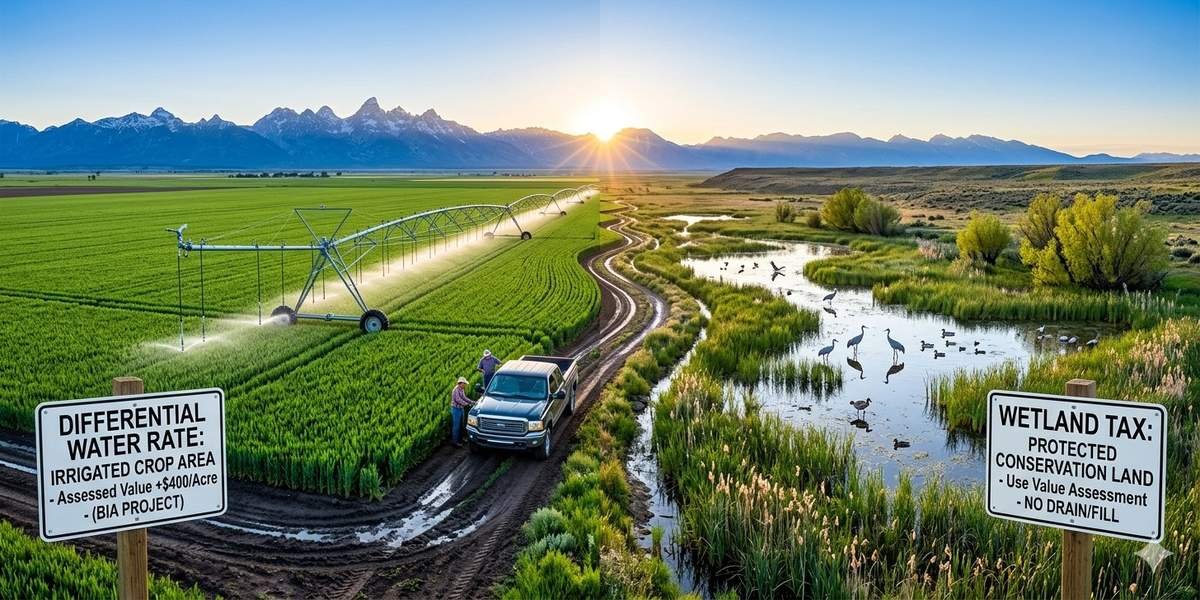
Most farmers can tell you the exact pH level of their soil just by looking at the color. But ask them about their property tax classification? That’s where the confident nods usually stop. Every year, huge farming operations bleed money. Not because the crops failed, but because someone checked the wrong box on a tax form. One of the most misunderstood concepts in this space is the differential water rate. People hear “water” and “tax” and assume it’s all the same bucket of money. It isn’t. Confusing this rate with wetland tax rules is a fast track to an IRS audit or a massive overpayment. We’re going to peel back the layers on these two concepts and show you exactly where 2026 regulations are headed.
What Exactly Is a Differential Water Rate?
Let’s get the definition straight. In the world of agricultural taxation, the differential water rate is a specific charge. It applies to water taken from government-run irrigation projects and used on land that was originally “dry.”
Think of it as a value-bridge. Dry land has a certain assessed value. Once you pump government-managed water onto it, that land becomes more productive. Its market value shoots up. The government uses this rate to account for that jump in value. It’s essentially the price of turning a dusty patch of dirt into a high-yield asset.
For the 2026 fiscal year, the Bureau of Indian Affairs (BIA) has pushed most of these rates higher. For example, the Colorado River Irrigation Project saw its basic per-acre rate climb from $69.00 to $85.00. That’s a 23% jump. If you’re an executive managing ten thousand acres, that isn’t just “pocket change.” It’s a line item that can rewrite your entire annual budget.
How the Assessment Gap Works in Practice
Imagine you have a plot of dry land valued at $500 per acre. If a federal project brings water to that boundary, the value might leap to $950. The $450 difference is what the tax mechanism targets. For corporate teams, this affects more than just the tax bill. It changes your balance sheet. It shifts your collateral value for bank loans. If you don’t account for the differential water rate correctly, your financial reporting is essentially a work of fiction.
The Wetland Tax: A Completely Different Animal
Here is where the confusion starts. A “wetland tax” sounds like it should be related to irrigation. It isn’t. Not even close.
Wetland taxes deal with land that is naturally wet. We’re talking about bogs, swamps, marshes, and floodplains. This water isn’t coming from a government pipe; it’s there because nature put it there. Instead of being a rate you pay for a service, wetland tax treatment is usually a “preferential assessment.”
According to the National Agricultural Law Center, all 50 states have some version of a “differential tax assessment” for conservation land. If your land is classified as a wetland, the state might tax you at its “use value” (what it’s worth as a swamp) rather than its “market value” (what it would be worth if you built a mall on it). This usually lowers your tax bill.
What the IRS Says (And They Aren’t Joking)
The IRS is very clear in Publication 225, the Farmer’s Tax Guide. You cannot deduct expenses for draining a wetland. You also can’t deduct the cost of filling one in to make room for a tractor. If you try to turn a wetland into “irrigated dry land” to claim different benefits, you’ll likely lose both and face a penalty.
Where the Lines Get Blurry (And Expensive)
Look, I get it. Both terms involve water. Both show up on your property assessment. Sometimes, a single farm has both types of land right next to each other.
Let’s look at a real-world scenario. A farmer in the West owns 1,000 acres.
- Section A: 300 acres are natural wetlands near a creek.
- Section B: 700 acres are dry but receive water from a BIA project.
The 300 acres of wetland might get a tax break from the state for conservation. But the 700 acres will be hit with a differential water rate assessment because of the federal water. If the accountant lumps these together, they might try to claim a conservation deduction on the 700 acres. That is a massive red flag.
In 2025, the IRS started using more satellite data to check land classifications on Schedule F filings. They can see if you’re watering a desert or preserving a marsh. Getting these mixed up isn’t just a “whoops” moment; it’s a data mismatch that triggers an inquiry.
Understanding the Differential Water Rate on Your Tax Return
When you pay those irrigation assessments, where do they go? Usually, they are deductible as soil and water conservation expenses under Section 175 of the tax code.
But there’s a catch. You can’t just deduct whatever you want. The deduction is capped at 25% of your gross income from farming.
- Example: If your farm makes $200,000 in gross income, you can only deduct $50,000 in conservation expenses this year.
- What happens to the rest? You don’t lose it. It rolls over to next year.
For 2025, the Social Security wage base for self-employment tax hit $176,100 (up from $168,600 in 2024, per IRS data). This matters because it changes your net earnings calculation. If you’re a corporate tax student, you need to see how these numbers ripple through the entire return. One change in an irrigation rate affects net income, which affects the Section 175 cap, which affects the carryover for next year. It’s all connected.
New 2026 Updates: Why the Numbers are Moving
If you’re managing a land portfolio, you need to watch the “discount rate.” In January 2026, the Bureau of Reclamation published the new federal water resources planning discount rate at 3.25%.
Why does a tiny 0.25% increase matter? Because the government uses this rate to decide if new water projects make sense financially. When the rate goes up, it’s harder for the government to justify building new pipes or dams. This means “dry” land is likely to stay dry longer. It makes existing water rights much more valuable.
Also, the BIA confirmed that most 2026 rate increases are staying. The Flathead Irrigation Project was a rare win for farmers—the government froze those rates at $39.00 for “A” acres. But every other project is getting more expensive.
Managing the Risks for Agribusiness Executives
For those in the C-suite of a major ag-firm, these aren’t just farming issues. They are valuation issues. If you are buying land, you need to perform “tax due diligence.”
- Is the land currently being billed a differential water rate?
- Are there “hidden” wetlands that restrict your ability to expand?
- Is the current owner’s Schedule F consistent with the physical land?
If you buy a property thinking it’s all “irrigated dry land” and find out half of it is protected wetland, your ROI just took a nose dive. You can’t farm it, you can’t drain it, and you can’t use the irrigation water on it.
Common Myths That Need to Die
- Myth 1: “If it’s wet, it’s a wetland.” Wrong. If you’re paying for the water, it’s likely an irrigation issue.
- Myth 2: “I can deduct the cost of a new pond on my wetland.” No. If that pond is for irrigation, and you disturbed a natural marsh to build it, the IRS will likely disallow the deduction.
- Myth 3: “The rates are the same every year.” Tell that to the guys in the Colorado River Project paying $85 per acre now.
Wrapping It Up
Honestly, agricultural tax isn’t a “set it and forget it” thing. It’s a living system. The differential water rate is a tool for progress—it’s what you pay to turn dry land into a powerhouse. Wetland tax rules, on the other hand, are about preservation. They reward you for leaving nature alone.
Mixing these up is the easiest way to lose money or attract the wrong kind of attention from the IRS. Whether you’re a student learning the ropes or an executive signing off on a multi-million dollar land deal, keep these two concepts in separate boxes. Stay on top of the BIA rate changes and the federal discount rates. It might seem like a lot of math, but it’s the only way to protect your bottom line.