You’re sitting in a glass-walled office, flipping through a thick stack of onboarding papers. The HR manager smiles and says, “Just a standard form. Everyone signs it.” You’re excited. You want the job. So, you scrawl your name on the Noncompetition Agreement: without a second thought. Fast forward two years. You get a better offer across town, but that “standard form” suddenly feels like a pair of handcuffs. Your boss mentions the legal team. Your stomach drops. Is your career actually on pause for a year? Maybe not. That “locked door” in your contract might actually be made of paper. This guide breaks down exactly how to spot a weak agreement and when the law actually takes your side.
The “Reasonableness” Reality Check
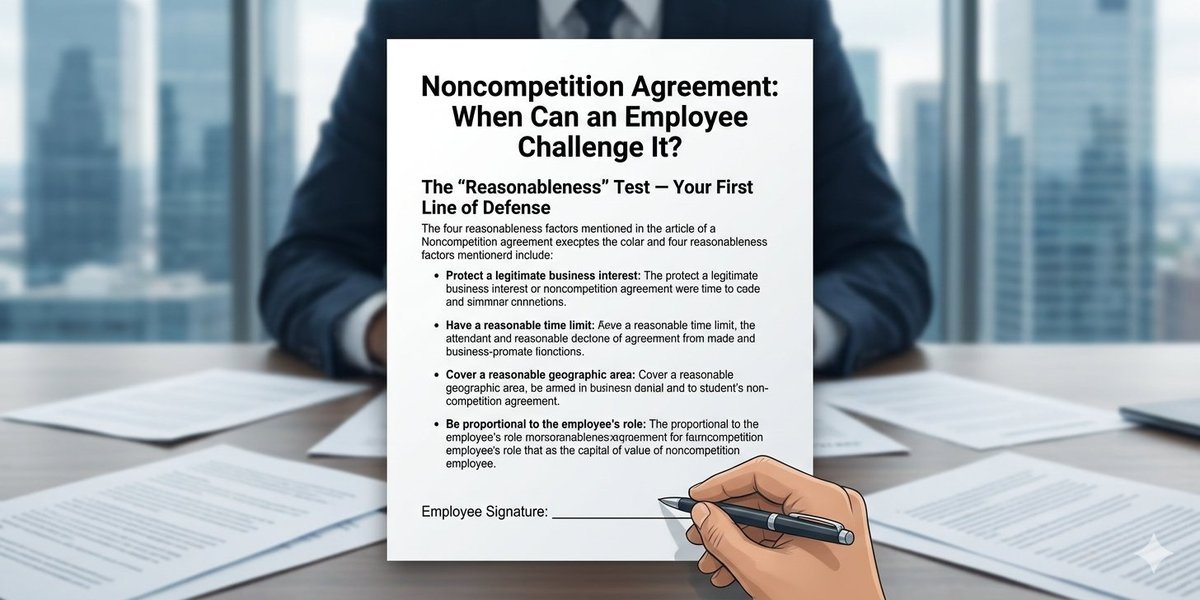
Most people think a contract is absolute. If you sign it, you’re stuck. But employment law doesn’t work like a typical sales receipt. Judges actually hate these restrictions because they stop people from earning a living. To hold up in court, a restriction must be “reasonable.” That’s a fuzzy word, but it usually means the company has to prove four specific things:
- A real business interest: They can’t just stop you because they don’t like competition.
- A fair time limit: Usually six months to two years.
- A fair map: They can’t ban you from working in the whole world if they only sell in Chicago.
- The right role: A CEO might have a valid ban. A delivery driver? Almost never.
If the company fails even one of these, a judge might throw the whole thing out. Some states use “blue-penciling.” This is where a judge takes a literal red pen to your contract and crosses out the illegal parts to make them smaller. But not every state allows this. In some places, if the company gets greedy and writes a bad contract, the whole thing dies.
Why Your State Map Matters Most
Non-compete law isn’t a federal thing. It’s a messy patchwork of state rules. Where you sit determines if you are trapped or free.
The Total Ban States
California is the king of worker freedom here. Under the California Business and Professions Code Section 16600, almost all non-competes are void. In 2024, they made the rules even tougher. Now, it is actually illegal for an employer to even ask you to sign one. Even if you signed a contract in a different state, California often refuses to recognize it. Minnesota joined this club in 2023, banning these agreements for almost everyone. Oklahoma and North Dakota have similar long-standing bans.
The Salary Thresholds
Other states use your paycheck to decide if you can be restricted. They figure if you aren’t making the big bucks, you aren’t a threat to the company’s survival. In Colorado, for example, a Noncompetition Agreement: is generally only enforceable if you earn over a certain amount ($123,750 as of 2024). Illinois, Washington, and Maine have similar “low-wage” protections. If you make $50,000 a year in these states, your non-compete is likely just a piece of scrap paper.
The Secret “Choice of Law” Trap
Look closely at the fine print. Does it say “This agreement is governed by the laws of Delaware” even though you work in Ohio? This is a common trick. Companies pick states with “boss-friendly” laws to try and bypass your local rights.
But here is the kicker: many local courts are starting to ignore these clauses. If you live, work, and pay taxes in a state that protects workers, a judge might decide that your home state’s laws trump whatever the company wrote. It’s a messy legal fight, but one that employees are winning more often.
What Counts as a “Legitimate” Reason?
A company can’t just say, “We don’t want Steve working for the guy across the street.” That isn’t a legal reason. They need a “protectable interest.”
Trade Secrets vs. General Skills
If you have the secret formula for a new soda, they can stop you. But if you just have “general industry knowledge,” they usually can’t. You own your brain. The skills you learned during your career belong to you, not your boss.
Client Relationships
Did you spend five years taking a client to lunch on the company’s dime? That is a legitimate interest. Companies want to protect those relationships. However, if you brought those clients with you from a previous job, the company’s claim gets much weaker.
The “Janitor Clause” Problem
This is a classic legal blunder. Some companies write contracts so broad that an executive would technically be banned from working as a janitor for a competitor. This is called “overbreadth.” When a company tries to stop you from doing any work for a rival, instead of just similar work, judges often see it as a “punishment” rather than protection.
The Missing Link: “Consideration”
In law, you can’t get something for nothing. For a contract to be valid, there must be an exchange. This is called “consideration.”
If you sign the agreement when you first start, the job itself is the consideration. But what if you’ve been there for three years and suddenly they hand you a new Noncompetition Agreement: to sign? If they don’t give you a raise, a bonus, or a promotion in exchange for that signature, many states (like Pennsylvania and North Carolina) will rule it invalid. Just “keeping your job” isn’t always enough of a reward to make the contract stick.
The FTC Rule: A Rollercoaster for Workers
In early 2024, the Federal Trade Commission (FTC) tried to change everything. They issued a massive rule that would have banned almost all non-competes across the entire United States. They estimated this would help 30 million people and boost wages by nearly $300 billion a year (FTC, 2024).
It felt like a victory for workers. But it didn’t last. A judge in Texas blocked the rule in August 2024, saying the FTC didn’t have the power to make such a big change. For now, the rule is dead. We are back to the state-by-state patchwork. But the fight showed one thing: the government is finally looking at how these deals hurt the economy.
Non-Competes vs. Non-Solicitation
Don’t confuse these two. A non-compete stops you from working. A non-solicitation agreement stops you from poaching.
Imagine you leave your job at a software firm.
- Non-compete: You can’t work for any other software firm for a year. (Hard to enforce).
- Non-solicitation: You can work wherever you want, but you can’t call your old clients or try to hire your old team for a year. (Very easy to enforce).
Most employers care more about the clients than where you sit. Often, you can negotiate with your old boss. You might agree not to touch their clients if they agree to let you take that new job. It’s a win-win that avoids a courtroom.
Practical Steps to Challenge the Contract
If you feel trapped, don’t panic. Take these steps before you quit:
- Check the “Breach”: Did your boss stop paying your commissions? Did they change your job role without asking? If the employer breaks the employment contract first, the non-compete usually dies with it.
- The “Garden Leave” Option: Ask if they are willing to pay you to stay home. Some high-end contracts include “Garden Leave,” where you get full pay while you wait out the ban. If they won’t pay you, it’s harder for them to argue that you shouldn’t be allowed to work elsewhere.
- Audit the Signing Process: Were you forced to sign it in five minutes? Were you told it wasn’t a big deal? If there was “duress” or misrepresentation, you have a fighting chance.
- Get a Pro: Spend a few hundred dollars on an employment lawyer. They can usually read a contract and tell you in twenty minutes if it’s “garbage” or “gold.”
Wrapping It Up
At the end of the day, a Noncompetition Agreement: is just a tool, and tools can break. The world is moving away from these restrictive deals because they stifle innovation. Whether you are a doctor in Chicago or a coder in Austin, the law is increasingly on the side of the person who wants to work. Don’t let a scary-looking document stop you from taking a better opportunity. Read the fine print, know your state’s rules, and remember that you own your career. The door is only locked if you believe it is.