
Imagine waking up to a squishy carpet. You follow the dampness to the hallway and see water cascading down your walls like a localized monsoon. A pipe burst three floors up. Your vintage leather sofa is soaked, and your custom walnut bookshelves are warping before your eyes. You call your insurance agent, feeling confident. Then comes the gut punch. They tell you that your policy covers the walls, but not the “finished” surfaces. Or maybe they cover the floors, but not the expensive upgrades you installed last summer. For many owners, this nightmare is a reality. Navigating strata title insurance is notoriously tricky because you aren’t just insuring a home; you’re insuring a slice of a much larger, shared machine.
What Is a Strata Title and Why Is It So Confusing?
At its core, strata title is a model of property ownership. It allows people to own individual units—like apartments, townhouses, or condos—within a larger complex. While you own your unit, you share the “common property” with your neighbors. This includes the roof, the elevators, the gym, and even the patches of grass out front.
This shared ownership is managed by a group usually called a Homeowners Association (HOA) in the US. Because the ownership is split, the insurance is split too. This is where the confusion starts. Who is responsible for the pipe inside the wall? What about the balcony railing? If the lobby floods, do you pay for it? The answers aren’t always clear, and the “gray areas” between your personal policy and the building’s policy can cost you a fortune.
The Two-Layer Shield of Strata Insurance
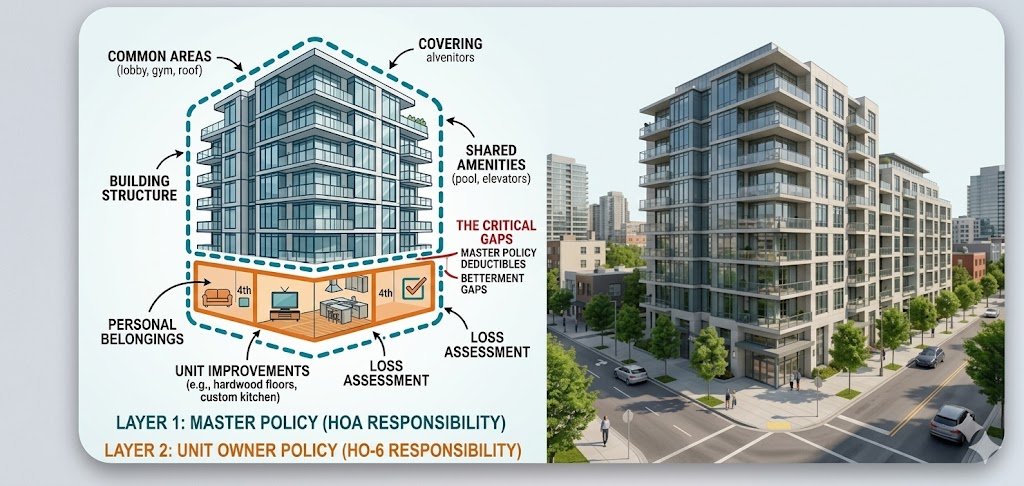
Think of your insurance as a two-layer cake. If one layer is missing or too thin, the whole thing falls apart when the pressure is on.
Layer One: The Master Policy (The HOA’s Job)
The HOA or body corporate buys a master policy. This covers the “big stuff.” Usually, this includes the building’s skeleton, the roof, and the shared amenities. In the US, these master policies generally fall into two categories:
- Bare Walls-In: This is the “skeleton” version. It covers the studs, the plumbing behind the walls, and the roof. It stops where your paint starts. If your kitchen cabinets are ruined by a leak, you’re on your own.
- All-In: This is more generous. It covers the original fixtures that came with the unit, like the standard tub, basic flooring, and original cabinets.
Layer Two: The HO-6 Policy (Your Job)
As a unit owner, you need an HO-6 policy. This is your personal safety net. It covers your clothes, electronics, and furniture. More importantly, it covers “improvements and betterments.” If you replaced the cheap builder-grade carpet with Brazilian cherry hardwood, your HO-6 policy is what protects that investment.
According to the Insurance Information Institute (III), about 60% of condo owners don’t have enough coverage for their actual contents and unit upgrades. That’s a huge gamble.
The Hidden Gaps That Bankrupt Owners
Even with both policies, you might be standing over a financial trapdoor. Let’s look at the gaps that most people miss until it’s too late.
The Master Policy Deductible Gap
This is the big one. Let’s say a fire starts in your kitchen. It causes $30,000 in damage to the building’s structure. The master policy covers it, right? Yes, but the master policy might have a $10,000 or $25,000 deductible. Many HOAs now pass that deductible directly to the unit owner if the damage started in their unit. If your personal policy doesn’t have “Deductible Assessment” coverage, you’ll be writing a very large check.
Loss Assessment: The “Surprise Bill”
What happens if a hurricane rips the roof off the clubhouse and the repair cost is $1 million more than the insurance limit? The HOA will send every owner a bill to cover the difference. This is a “special assessment.” If you have strata title ownership, you must check your “Loss Assessment” limit on your HO-6 policy. Most standard policies only give you $1,000 or $5,000. In a major disaster, that’s pennies. Experts often suggest carrying at least $50,000 in this category.
Betterment Gaps
If you bought a “fixer-upper” and spent $80,000 on a high-end kitchen, the master policy doesn’t care. If the building burns down, they will only pay to put back the basic, cheap kitchen that was there in 1985. You need to make sure your personal policy reflects the current value of your renovations.
| Coverage Type | What it Covers | Who Pays for it? |
| Building Master Policy | Roof, Lobby, Elevators, Exterior Walls | Paid through your HOA dues |
| HO-6 Personal Property | Clothes, Furniture, Tech, Jewelry | You |
| HO-6 Improvements | Your new granite counters or hardwood floors | You |
| Loss Assessment | Your share of a massive building-wide claim | You |
| Personal Liability | If a guest slips on your wet kitchen floor | You |
Pure Risk Premium: The Engine Under the Hood
For those of you studying for insurance designations or working in the corporate side, you need to know about “Pure Risk Premium.” This isn’t the price you see on your bill. It’s the raw, actuarial cost of the risk itself.
In a strata title environment, calculating this is a nightmare for underwriters. Why? Because you aren’t just betting on one person’s behavior. You’re betting on the collective behavior of 200 people. If the guy in 4B forgets his bathtub is running, it affects the people in 3B, 2B, and 1B. This “contagion risk” makes the pure risk premium for multi-unit buildings much higher than for standalone homes.
A 2023 report from the National Association of Insurance Commissioners (NAIC) showed that premiums for multi-unit residential properties jumped by about 11.4% in just two years. This wasn’t just greed. It was driven by the rising cost of labor and materials, combined with a higher frequency of “nuisance claims” like water damage from old appliances in high-density buildings.
How to Audit Your Coverage in 20 Minutes
Don’t wait for a disaster to find out you’re underinsured. Honestly, do this today.
- Get the “Dec” Page: Ask your HOA for the master policy’s Declaration Page. Look specifically for the words “Bare Walls” or “All-In.”
- Check the Deductible: Look at the master policy’s property deductible. If it’s $25,000, call your personal agent and make sure your HO-6 covers a “loss assessment” for that exact amount.
- The “Phone Walk”: Take your phone and record a video of every room. Open every drawer. This proves what you owned if everything is lost.
- Check for Exclusions: Most policies exclude floods and earthquakes. If you live in a high-risk area, you might need a separate “Difference in Conditions” (DIC) policy.
- Look at Your Limits: Is your personal property limit enough to replace everything you own at today’s prices? Remember, inflation has made everything from sofas to spoons much more expensive since 2021.
Why Your Neighbors’ Choices Matter
Here is a weird truth about strata title living: you are financially tied to your neighbors. If the building next door has a lot of claims, your rates might stay low. But if your building has three kitchen fires in two years, the “loss history” for the entire complex gets stained. This drives up the master policy premium, which then drives up your monthly HOA dues. It’s a collective risk. That’s why many high-end corporate strata managers now require every tenant to show proof of personal insurance. It protects the whole group.
Wrapping It Up
Owning a strata title property is a great way to build wealth and enjoy a low-maintenance lifestyle. But the insurance side isn’t “set it and forget it.” You can’t just assume the building’s policy has your back. Usually, it only covers the shell. The rest—the stuff that makes your unit a home—is on you.
Check your “Loss Assessment” limits. Understand the difference between “Bare Walls” and “All-In.” And most importantly, talk to your agent about the master policy deductible. A little bit of boring paperwork today can save you from a $50,000 headache tomorrow. Insurance is about more than just paying premiums; it’s about knowing exactly where your protection ends and the risk begins. Don’t leave your biggest investment to chance.


