
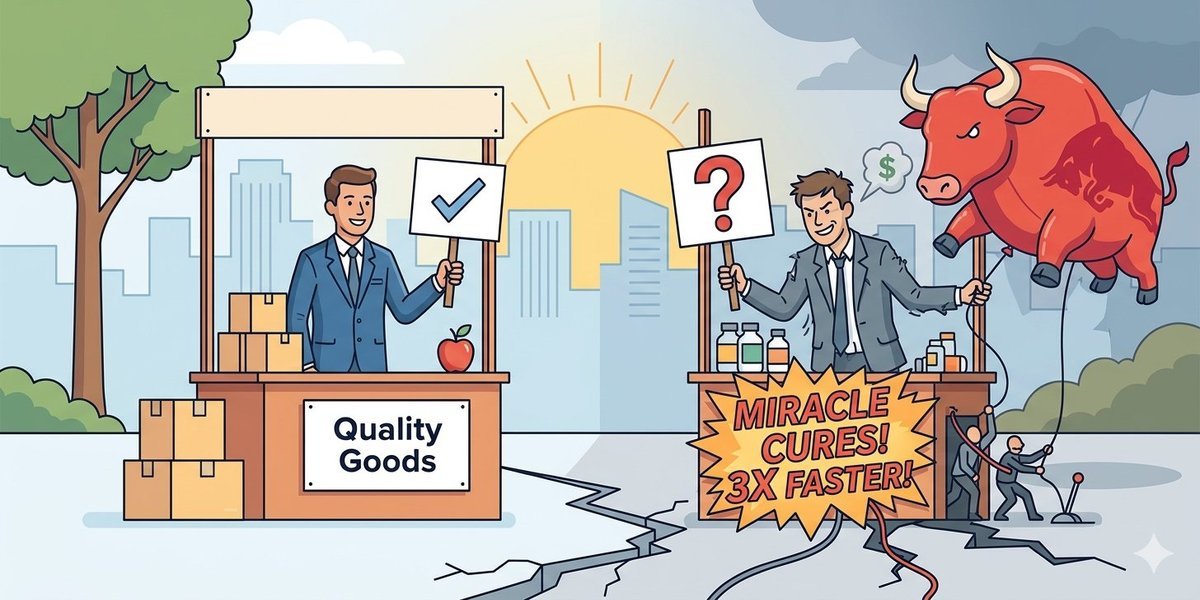
A supplement bottle in your hand claims to “melt fat 3x faster than a marathon.” A pillow brand swears its foam is “NASA-grade.” No data. No lab reports. Just bold claims printed in bright colors to get your credit card out of your wallet. This isn’t just annoying marketing. In the eyes of the law, it’s often illegal. These tactics fall under the umbrella of unfair competition, a legal term that stops businesses from cheating their way to the top. This article breaks down what makes an ad a lie, how the government fights back, and why some of the biggest brands in the world ended up paying millions for “stretching the truth.”
The Fine Line: Puffery vs. Deception
Not every boast is a crime. If a local diner claims they have the “World’s Best Omelet,” they aren’t going to jail. Why? Because the law recognizes “puffery.” This is basically harmless bragging that no sane person takes as a literal, scientific fact. It’s an opinion.
But things change fast when you start using numbers or specific promises. If that same diner says, “Our omelets have 50% more protein than any other brand,” they better have the lab results to prove it. Once you move from “we’re great” to “here is a specific fact about our product,” you’ve crossed the line.
An ad becomes legally misleading when it contains a false statement of fact. It can also be illegal if it leaves out a massive piece of information that changes how a customer sees the deal. It’s the difference between saying you’re “fast” and saying you “reach 60 mph in 2.4 seconds.” One is a vibe. The other is a measurement.
Different Flavors of Deceptive Ads
How do companies actually trick people? It’s usually not one big lie. It’s often a series of small, shady choices.
- Flat-out Lies: Claiming a juice cures cancer or a car gets 90 mpg when it actually gets 30.
- The Half-Truth: Telling you a snack is “sugar-free” but hiding that it’s packed with fats that are just as bad for your heart.
- Bait-and-Switch: You see an ad for a $200 laptop. You go to the store, and they “just sold out,” but they have a $600 model ready for you.
- Fake Reviews: Paying people to write five-star gushy comments on Amazon or Yelp without saying they were paid.
- The “Before and After” Photoshop: Using lighting, angles, or digital editing to make a weight loss or skin cream result look impossible.
The numbers show this is a massive problem. In 2021, the Federal Trade Commission (FTC) took in over 2.8 million fraud reports from consumers. Deceptive marketing was a huge part of that pile. Source: FTC Consumer Sentinel Network Data Book, 2021.
Why Unfair Competition Matters to You
Look, the term unfair competition sounds like something only lawyers in suits care about. But it affects every dollar you spend. It’s a big category of law that protects the market. False advertising is just one part of it. This area of law also stops companies from stealing each other’s secret recipes or copying logos to confuse you.
At the federal level, we have the Lanham Act. This is the big stick. It lets a company sue its rival if that rival is lying to steal customers. You have to prove the lie actually hurt your sales. Then there are state laws. California’s Unfair Competition Law (UCL) is famous for being incredibly tough. It doesn’t just look for lies; it looks for anything “unfair” or “fraudulent.” If you run a business in New York, Texas, or Florida, you have to watch these state rules just as closely as the federal ones.
When Huge Brands Get Caught
You might think big companies are too smart to get caught. You’d be wrong. Sometimes the pressure to hit sales targets makes people do dumb things.
The Red Bull “Wings” Fiasco
In 2014, Red Bull had to settle a class-action suit for $13 million. Why? Because they claimed the drink could improve your concentration and reaction speeds. Customers argued that the drink didn’t really do anything more than a standard cup of coffee would. Red Bull didn’t admit they lied, but they paid the money anyway to make the case go away. Source: Careathers v. Red Bull GmbH, 2014.
The Skechers “Shape-Ups” Scamos
Remember those shoes with the curved bottoms? Skechers claimed you could tone your butt and lose weight just by walking in them. They even used celebrities to push the idea. The problem? There was zero science to back it up. They ended up paying $40 million to the FTC. Source: FTC Press Release, May 2012.
The Volkswagen Emissions Scandal
This is the heavyweight champion of misleading ads. VW told the world their diesel cars were “clean.” In reality, they installed secret software to cheat on emissions tests. When they got caught, it wasn’t just a small fine. It cost them over $30 billion in fines and legal fees. Source: U.S. Department of Justice, 2016.
How the Court Decides Who Wins
If a company sues a competitor for a bad ad, they have to check five specific boxes under the Lanham Act. If they miss even one, the case usually falls apart.
- The Lie: Did the defendant actually make a false or misleading statement?
- The Context: Was this statement in a real ad or a promotion? (A private email doesn’t count).
- The Deception: Did the ad actually trick a good chunk of the people who saw it?
- The “So What” Factor: Was the lie important enough to change someone’s mind about buying the product?
- The Damage: Did the plaintiff lose money or customers because of this?
If a judge decides the ad was illegal, they can do a few things. They can issue an injunction, which is a fancy way of saying “Stop running that ad right now.” They can also make the company pay for “corrective ads.” That’s when a brand has to run a new ad essentially saying, “Hey, we lied in our last one. Here is the truth.”
Advice for Future Leaders and Students
If you’re a law student, memorize the five-factor test above. You’ll see it on every exam. Pay attention to how the court splits hair between a “fact” and a “vibe.” That distinction is where cases are won.
If you’re an executive or a business owner, listen up. Your marketing team is creative, and that’s great. But they need a filter. One bad tweet or a misleading TikTok ad can spark an FTC probe that lasts years. It’s much cheaper to pay a lawyer to check your ads today than to pay a $40 million settlement tomorrow.
Ask your team these four things before you go live:
- Can we prove every single claim with a study?
- Are our “real people” in the ads actually real?
- If we compare ourselves to a rival, is that data current?
- Do the photos make the product look bigger or better than it really is?
Wrapping It Up
At the end of the day, unfair competition laws keep the world honest. Without them, the loudest liar would always win the most customers. That would be a disaster for everyone. Whether it’s a massive car company cheating on smog tests or a small pill company lying about weight loss, the rules stay the same. You can be bold. You can be loud. But you have to be honest. If you’re a student, use this as your guide to the world of commercial law. If you’re in business, treat these rules as your guardrails. Honest competition is the only way to build a brand that actually lasts.


