Forget the generic political slogans you heard on the news last July. When President Trump signed the “One Big Beautiful Bill” (OBBB) into law on Independence Day 2025, the fireworks were just a distraction from the real math. Most people focused on the flashy tax cuts for tips and overtime. But if you look at the plumbing of the global supply chain, there is a ghost in the machine. Tax experts are worried about a structural flaw that could trigger a cascade tax effect. This isn’t just a boring accounting glitch. It’s a hidden mechanism where taxes pile on top of taxes, quietly inflating the price of everything from your morning coffee to a new fleet of corporate delivery vans.
What exactly is shifting? We are going to look at the new 1% remittance tax, the strange reality of Section 899 retaliatory measures, and why the IRS is losing its “teeth” when it comes to catching big-league tax fraud.
The Hidden Mechanics: What Is a Cascade Tax?
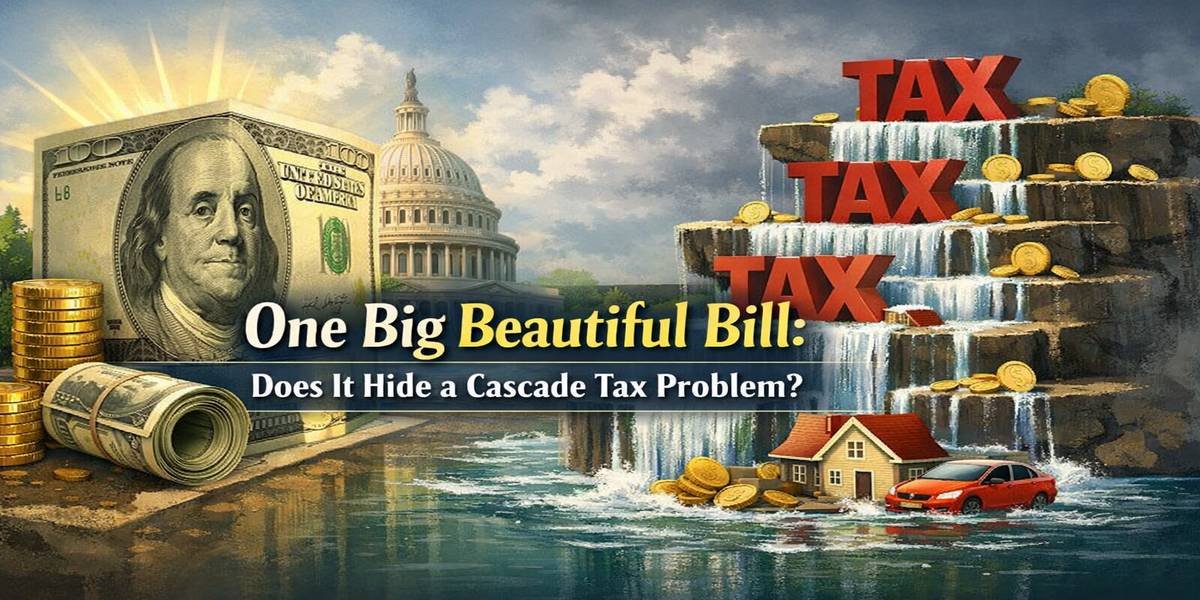
Let’s keep this simple. A cascade tax is essentially a tax on a tax. In a healthy system like a Value-Added Tax (VAT), a business gets a credit for the taxes they already paid on raw materials. Not here. In a cascading setup, the tax is applied to the total value at every single stop.
Think of it like a snowball. A timber company pays a tax to sell wood to a furniture maker. That tax is baked into the price. Then, the furniture maker pays another tax to sell the chair to a wholesaler. Now, they are paying tax on the wood, the labor, and the first tax. By the time that chair hits a showroom floor, the consumer is paying a price that has been artificially bloated by three or four layers of invisible levies.
The OBBB Breakdown: The Good and the Weird
The OBBB is a massive document. It’s hundreds of pages of legalese that most people will never read. Here are the hard numbers and facts you need to know for the 2026 tax year:
- TCJA Permanence: The 2017 tax brackets (10%, 12%, 22%, 24%, 32%, 35%, and 37%) are now permanent. No more “tax cliffs” at the end of the year.
- The Tip and Overtime Break: You can now earn up to $25,000 in tips and $12,500 in overtime pay completely tax-free.
- The Senior Bonus: Taxpayers aged 65 and older get a new $6,000 deduction. This stays in place until 2028.
- SALT Relief: The State and Local Tax deduction cap jumped from $10,000 to $40,000 for households making under $500,000.
- Bonus Depreciation: The OBBB brought back 100% bonus depreciation. This is huge for companies buying heavy equipment or machinery.
According to the Tax Policy Center, about 70% of the net benefits of these cuts will flow to the top 20% of earners in 2026. Specifically, households making over $916,900 are looking at nearly $1 trillion in cumulative cuts over the next decade. That’s a lot of capital moving around, but where it hits the floor is where things get messy.
Why Section 899 and Remittances Create a Cascade Tax Problem
Here is where the article gets into the weeds. Two specific parts of the OBBB are acting like “stealth” turnover taxes.
The 1% Remittance Tax
Starting January 1, 2026, a new 1% excise tax applies to remittance transfers. If a worker sends money to family outside the U.S., the government takes a cut at the window. On the surface, it’s a small fee. But for businesses that use international wire transfers to pay for overseas components, this is an added layer of cost that cannot be “credited” back. It is a pure transaction tax.
Section 899 Retaliation
The U.S. is currently in a trade war over Digital Services Taxes (DSTs). The OBBB introduced Section 899, which allows the government to slap higher tax rates on companies from countries that “unfairly” tax American tech giants. When a U.S. manufacturer buys parts from a French or British supplier hit by Section 899, those higher costs get passed down the line. Because there is no offset for these retaliatory taxes, we are right back in cascade tax territory. It’s a game of fiscal dominoes where the last person in line—the consumer—loses.
The Shrinking Power of IRS Enforcement
While the bill adds new ways to tax transactions, it takes away the tools to police them. The OBBB clawed back a massive portion of the $80 billion previously given to the IRS. Honestly, this is a huge deal for corporate governance.
When you cut the enforcement budget, you aren’t just losing paperwork pushers. You are losing the ability to conduct serious criminal investigations. In tax law, “search and seizure” is the ultimate weapon. Under Section 7602 of the Internal Revenue Code, the IRS has the right to examine records and even seize assets if they suspect high-level fraud.
But those operations are expensive. They require specialized agents and years of auditing. With a smaller budget, the IRS will likely do fewer audits. The Institute on Taxation and Economic Policy (ITEP) pointed out that Tesla reported $2.3 billion in U.S. income in 2024 but paid $0 in federal income tax. Their three-year effective rate was just 0.4%. If the IRS doesn’t have the funds to investigate these massive discrepancies, the “big fish” might just swim away.
A Lesson for Students and Executives
If you are a student, look at the OBBB as a case study in “unintended consequences.” You can lower the income tax rate for a billionaire while simultaneously making a loaf of bread more expensive through stacked excise taxes. It’s a trade-off.
For the executives out there, it’s time to talk to your tax counsel. You need to map out your supply chain. Look for “tax friction” points. Are you paying the 1% remittance tax on supply payments? Are your foreign vendors caught in the Section 899 crossfire? If your business involves several stages of production, you might be absorbing a cascade tax without even realizing it.
The drop in IRS enforcement also changes your risk profile. While nobody wants an audit, a toothless IRS creates a “Wild West” environment. In the long run, that can lead to market instability and unfair competition from companies that decide to play fast and loose with the rules.
Wrapping It Up
The One Big Beautiful Bill is a mixed bag of massive relief and hidden traps. Most Americans will be happy to see more money in their Friday paycheck thanks to the overtime and tip exemptions. Those are real, tangible wins for the working class.
But we can’t ignore the structural rot. When you layer excise taxes on top of tariffs and retaliatory duties, you create a cascade tax that acts like a silent inflation machine. Prices go up, not because of “greed,” but because the tax code is literally forcing them to. Combine that with a weakened IRS that can no longer perform effective search and seizure, and you have a system that is both more expensive for the honest and easier for the dishonest.
The fireworks from the Fourth of July are long gone. Now, we are left with the fine print. And in tax law, the fine print is where the real story lives.