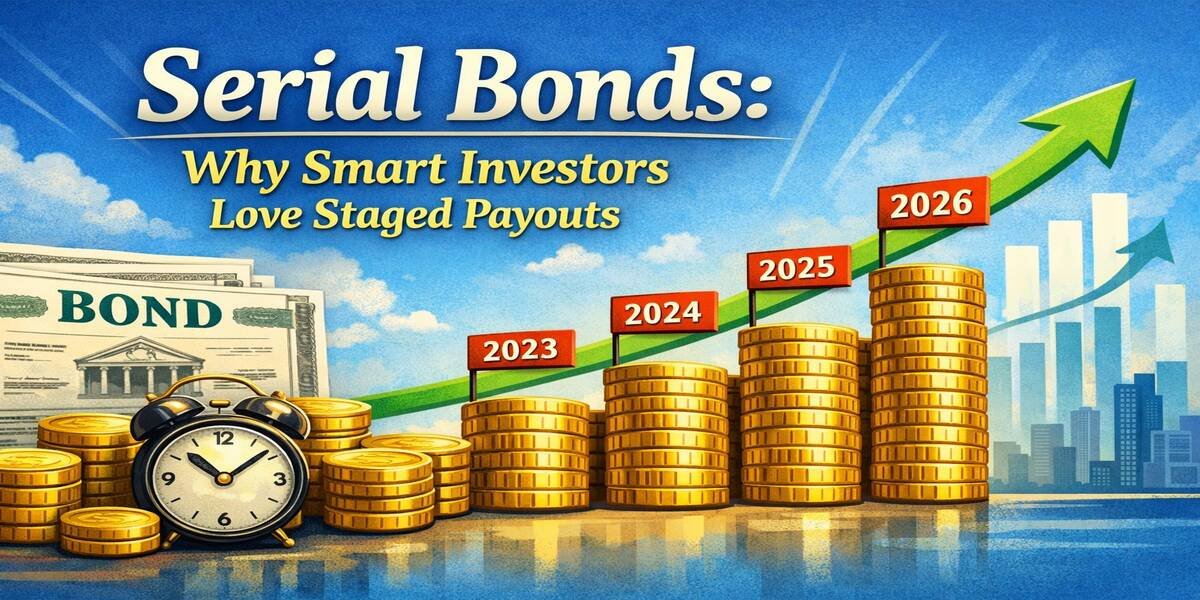
Think of the last time you lent a friend a hundred bucks. Would you rather get the whole amount back in five years, or have them pay you twenty dollars every year until the debt is gone? If you picked the second option, you know the appeal of Serial Bonds. These aren’t your typical “wait-and-see” investments. While most bonds make you wait until a single maturity date to see your principal again, serial structures break that payment into pieces.
It is a bit like a mortgage in reverse. Instead of a massive “balloon” payment at the end, the borrower pays off chunks of the debt over time. This guide breaks down how these instruments work, why cities love them, and why they might be the missing piece in your portfolio.
What Makes Serial Bonds Different?
Most people in finance are used to “term bonds.” You buy the bond, collect interest for ten years, and get your initial investment back on one specific day. It’s simple, but it’s also risky. If the market crashes on that exact day, or if the borrower doesn’t have the cash ready, you’re in trouble.
Serial bonds change the game by using a staggered schedule. Imagine a city needs $10 million for a new high school. Instead of paying it all back in 2045, they might schedule $500,000 to mature every year for twenty years.
Each of those annual payments is actually a separate bond with its own identification number, known as a CUSIP. So, when you buy into a serial issue, you aren’t just buying one “thing.” You are buying a collection of mini-bonds that retire at different times.
The CUSIP Factor
Every year, a serial issue has its own unique CUSIP. This matters for liquidity. If you own the portion maturing in 2028, you can’t just swap it for the 2030 portion. They are different financial products. For a corporate executive, this means more paperwork, but it also means more control over exactly when cash hits the balance sheet.
How the Mechanics Actually Work
The setup is pretty logical. When an organization—usually a city or a school district—decides to borrow money, they create a maturity schedule. They don’t just guess these dates. They match them to when they expect to have tax money coming in.
Here is the kicker: different maturity dates usually have different interest rates. In a normal economy, a bond maturing in two years will pay a lower rate than one maturing in twenty years. Why? Because you are taking on more risk by letting someone hold your money for two decades.
The Yield Curve Reality
Look, finance textbooks say long-term rates are always higher. But sometimes the world gets weird. During “inverted yield curve” periods, as we saw in 2023 and 2024, short-term bonds can actually pay more than long-term ones.
| Maturity Year | Interest Rate (Example) | Risk Level |
| 1-3 Years | 3.5% | Low (Price stays stable) |
| 5-10 Years | 4.2% | Moderate |
| 15-20 Years | 5.0% | Higher (Sensitive to rate hikes) |
Why Municipalities Rule This Space
If you look at the data, cities and counties are the kings of this structure. According to the Municipal Securities Rulemaking Board (MSRB), over 60% of municipal bonds use a serial structure. This isn’t just a random choice.
Public projects, like water treatment plants or toll roads, generate money every month. It makes sense to use that steady stream of “user fees” to pay down the debt gradually. It keeps the city’s budget predictable. Nobody wants to wake up in ten years and realize they owe $100 million all at once without a plan to pay it.
Budgeting Certainty
Finance officers at the city level love sleep. They don’t want to worry about “refinancing risk.” If a city uses term bonds, they have to hope interest rates are low when the bond matures so it can borrow again to pay off the old debt. With serial bonds, they just pay as they go.
The Stealthy Strategy of Serial Bonds
You might have heard of a “bond ladder.” That is when an investor buys several different bonds with different end dates. It is a great way to make sure you always have cash coming in.
But here is the thing. Serial bonds have a built-in ladder. Because the principal comes back in stages, you aren’t forced to reinvest a massive pile of cash all at once. If interest rates are terrible this year, you only have to worry about reinvesting the small portion that matured. The rest of your money is still working at the old rates.
Automatic Diversification
Time is a massive risk factor in investing. By spreading out the maturity dates, you are diversifying across time. You get some money back when rates are high and some when they are low. Over a decade, this usually averages out to a much smoother ride for your portfolio.
Addressing the Risks: It’s Not All Sunshine
No investment is perfect. Honestly, if someone tells you an asset has no downside, run the other direction. Serial bonds have a few quirks that can trip up even experienced corporate executives.
The Call Provision Trap
Many of these bonds come with a “call” feature. This means the issuer can basically “fire” the bondholders. If interest rates drop from 6% to 3%, the city might decide to pay you back early and borrow money elsewhere for cheaper.
This is annoying for you. Suddenly, your high-paying investment is gone, and you have to find a new place for your cash in a low-rate environment. Always check the “Yield to Worst” on your statement. It tells you the lowest return you can expect if the issuer calls the bond at the earliest possible date.
Inflation: The Silent Killer
While serial structures help with interest rate changes, they can’t stop inflation. If you are getting a fixed payment in 2040, that money probably won’t buy as much as it does today. Since you are locked into a schedule, you can’t easily pivot if inflation spikes to 8% or 9%.
Comparing Serial Bonds to Sinking Funds
People get these two confused all the time. It is a common mistake in finance exams. Let’s clear it up once and for all.
- Sinking Funds: The issuer puts money into a “savings account” every year. The bonds themselves usually all mature on the same date. The money is just sitting there waiting.
- Serial Bonds: There is no savings account. The issuer just pays the bondholders directly, and the bonds disappear from the books year by year.
For the investor, the serial structure is usually cleaner. You know exactly when your specific CUSIP will pay out. With a sinking fund, the issuer might use a lottery to decide whose bonds get retired early. Who wants their retirement plan left to a random drawing?
Real-World Case: California Schools
Let’s get specific. In 2022, California school districts issued about $2.8 billion in debt. Data from the California Debt and Investment Advisory Commission shows that a huge portion of this was serial. Why? Because property taxes—the main way schools get money—are paid every year. The schools match their debt payments to those tax checks. It is a perfect marriage of “money in” and “money out.” For a finance student, this is the ultimate example of matching assets to liabilities.
Who Should Actually Buy These?
Not everyone needs a staged payout. If you are 22 and looking for 10x returns, go buy a tech stock. These bonds are for people who value sleep over excitement.
- Retirees: If you need to pay for a grandkid’s college in 2028 and a new car in 2030, you can buy specific maturities to match those dates.
- Pension Funds: These institutions have “liabilities”—meaning they have to pay out retirement checks every month. Serial bonds provide the perfect cash flow to meet those checks.
- Conservative Corporates: If a company is sitting on extra cash but needs it back in stages for future expansions, this is a solid parking spot.
Wrapping It Up
At the end of the day, Serial Bonds are about control. They take the “all-or-nothing” gamble out of bond investing and replace it with a disciplined, rhythmic repayment schedule. You get your interest, you get your principal back in waves, and you reduce the chance of getting crushed by a single bad market day.
They aren’t the flashiest tool in the shed. But for students and executives who want to build a resilient financial foundation, they are indispensable. Whether you are funding a new bridge or just trying to protect your savings, these staged payouts offer a level of predictability that is hard to find elsewhere. Sometimes, the “boring” path is actually the smartest one to take.